
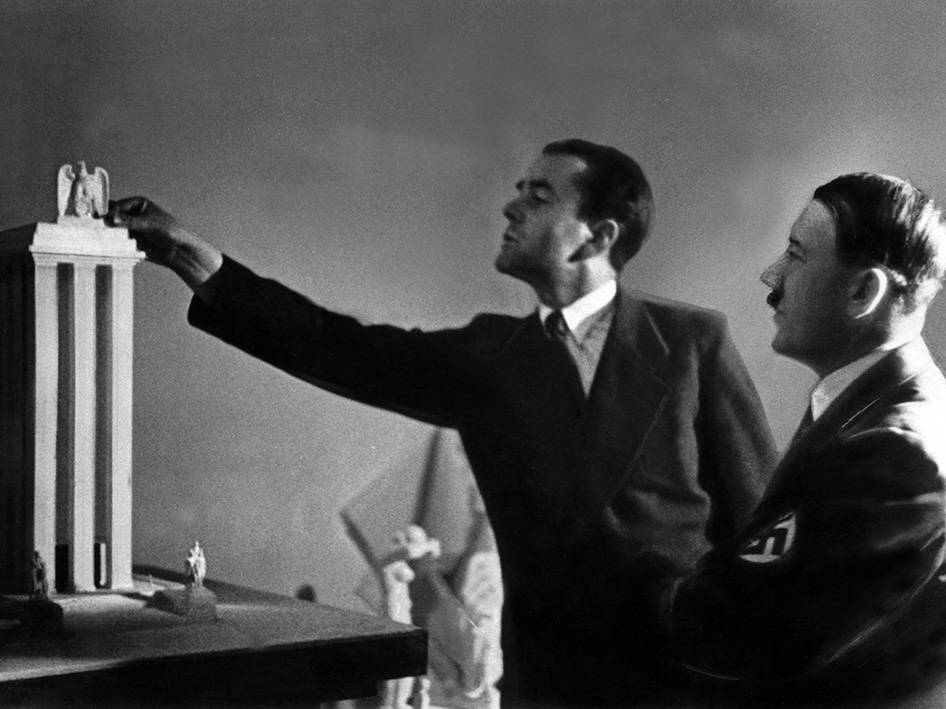
In 1976, Albert Speer wrote to the German journalist and Social Democrat politician Hety Schmitt-Maas that he had “skimmed” part of Primo Levi’s Auschwitz testimony If This Is a Man (1947). Two weeks later, losing interest, he added that he no longer wished to “disturb” Levi by reading his book. To this puzzling utterance Schmitt-Maas shot back: “I find it a great pity that you have not yet read If This Is a Man; if you did, the insanity and diabolism of the Nazi system would finally be made clear to you.”
Speer never replied to Schmitt-Maas, who secretly hoped that Speer might correspond with Levi. After his 20 years in Spandau Prison for war crimes and crimes against humanity, Speer had done the necessary “labour of mourning” (trauerarbeit) to atone for his part in the Nazi regime. Levi disagreed with Schmitt-Maas on that score and wanted nothing further to do with Hitler’s faithful former paladin. He need not have worried. On 1 September 1981, Speer died of a cerebral haemorrhage while in a London hospital. “I would have had some problems with writing to this ambiguous fellow,” Levi commented. As the Führer’s minister of armaments and war production, Speer had ruthlessly exploited Jewish slave labour at Auschwitz.
Speer, the handsome, slyly watchful Hitlerite, is the subject of You Are the Führer’s Unrequited Love by the French writer Jean-Noël Orengo. The book has been shortlisted for many awards, including the Goncourt Prize. I wish I could join in the applause, but I am puzzled by it. As a postmodern mishmash of biography, history and fiction, the book is clever and often seems to speak the language of literary theorists. But its many asides to the reader (“we must now… disrupt the comfortable linear flow of the narrative”) begin to look like self-reflexive preening.
Speer, himself a virtuoso fabricator and deviser of weaselly self-exculpations, is upheld by Orengo as an exponent of so-called autofiction. The memoirs that Speer drafted on lavatory paper and other scraps while detained in Spandau between 1946 and 1966 are a web of such falsehoods, says Orengo, that they are best read as semi-invention. (“Of all the autofictions I have read, Inside the Third Reich is the most radical,” Orengo remarks of Speer’s 1969 bestseller.) Speer is thus made to keep company with the likes of Annie Ernaux, Rachel Cusk and Karl Ove Knausgård. Is that appropriate?

Orengo’s book works well enough as biography. Speer, the Nazi regime’s official architect roughly from 1933 to 1942, was very much part of Germany’s Nazified upper bourgeoisie. Orengo compares the emotionally buttoned-up Speer to a character out of Thomas Mann (never mind that Mann was a vehement anti-Nazi). His kitschy architectural visions for the Third Reich won Hitler’s admiration and soon the fawningly complaisant functionary was “one of the Almighties of that time” (as Levi put it). Speer won the gold medal at the 1937 Universal Exhibition in Paris for his design of a tall building topped by a giant Nazi eagle, with a statue of naked Teuton gladiators at the base. His Reich Chancellery building – another monument to totalitarian grandiosity – was razed to the ground by the Soviets, Orengo reminds us, and its marble used to renovate an East Berlin metro station. So much for the thousand-year Reich.
Orengo wonders if there was a homoerotic component to the Hitler-Speer mutual infatuation. But the Führer’s embrace of Speer’s chiselled neoclassical warrior motifs and phallic Doric columns was probably just poor taste. Towards the end of his book, Orengo introduces Gitta Sereny, the real-life, half-Jewish Austrian writer who spent years researching her extraordinary life of Speer. At the Nuremberg trials, Speer had convinced his prosecutors he knew nothing of Hitler’s industrialised killing of Jews and other “useless mouths”. Sereny was convinced he was lying.
Speer was able to shut off a part of his conscience because the fragmentation of responsibility in Hitler’s Germany – the division of labour among the functionaries – made the contribution of any single person seem unimportant. Speer felt no more responsible, morally, for putting thousands of Jews to work in Auschwitz than did the Jewish squads forced by the SS to shepherd fellow Jews to the gas chambers. Speer had long ago departed from the community of civilised human beings.
You Are the Führer’s Unrequited Love
Jean-Noël Orengo, trs David Watson
Penguin Classics, 256pp, £14.99
Purchasing a book may earn the NS a commission from Bookshop.org, who support independent bookshops
[Further reading: Meet the Angry Young Women]
Content from our partners



Related


This article appears in the 15 Apr 2026 issue of the New Statesman, Angry Young Women
Join the debate
Subscribe here to comment